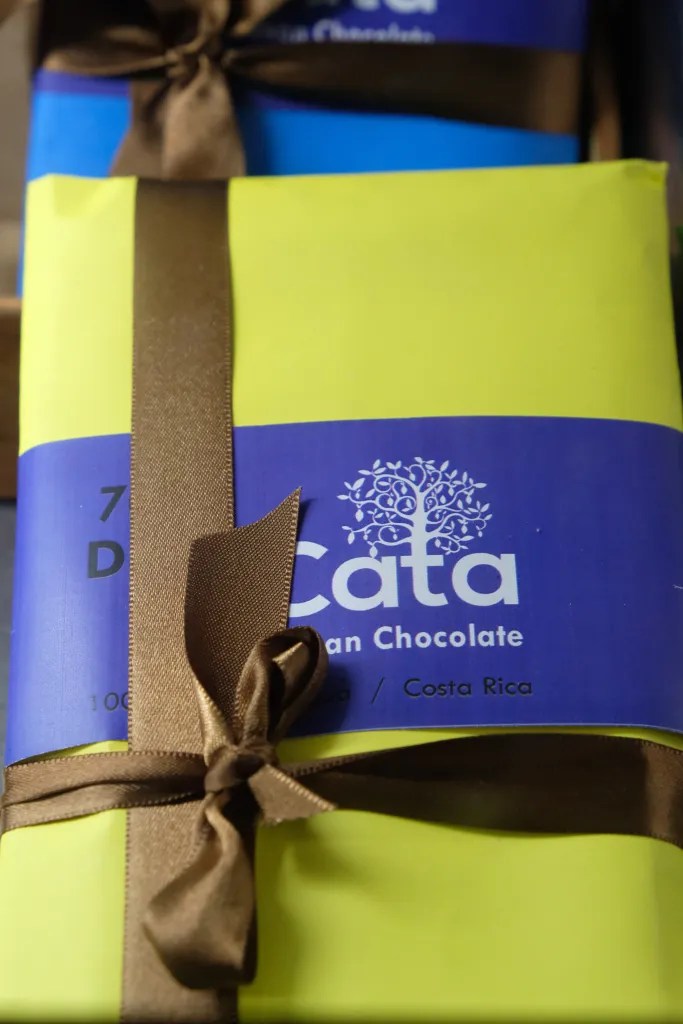
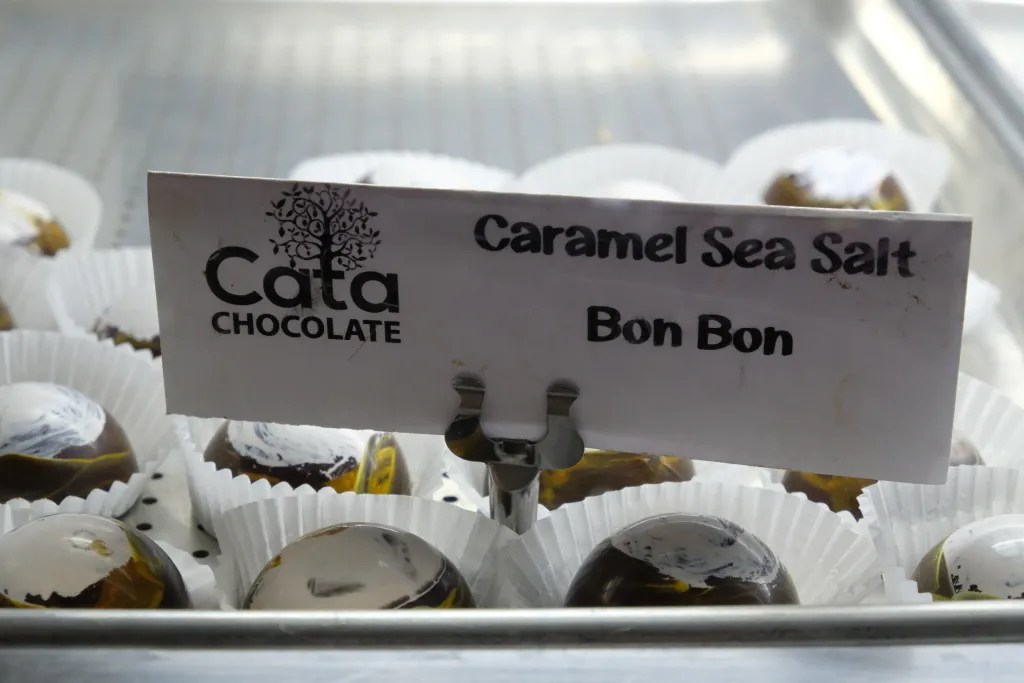
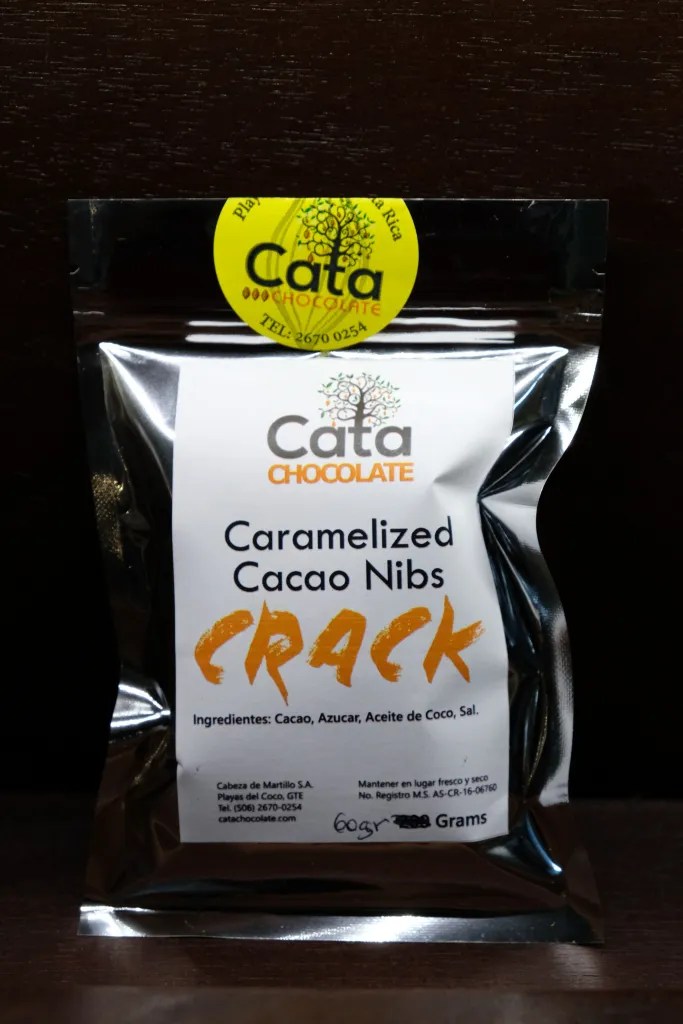
Leaving the unrest of Nicaragua behind us our next stop was Costa Rica, and I was beyond excited for more chocolate stops. First up was family owned and run Cata Chocolate in Playas del Coco on the Pacific coast, where the main road runs down to the water and the shop sits just upstairs. It is here where Sam discovered his new favourite chocolate snack – Cocoa Crack.
Cata, founded by a local entrepreneur Freddy Barahona, started life as a quaint little chocolate shop in this sleepy seaside resort town. Not one to do things by halves, Freddy is also the founder of Artesanos Cigars, the Solo Bueno artisan shop, and offers ‘tree-to-bar’ chocolate experiences, with trips to the farm he owns in Bijagua where the cacao is grown and harvested. Freddy is not there when we visit, primarily because this is a somewhat spontaneous visit and slight detour for us. But a detour very much worth taking nonetheless. Freddy’s daughter, a Food Engineering student, welcomes us in and doesn’t miss a beat when I ask her if it’s ok I interview her for the blog. If anything she is delighted, so long as she remains anonymous.
Like many of the chocolate makers I learn about on my travels, the Cata story starts, as so many of the best ones do, with something completely different.
“We first had a store where we just sold the cigars that we made,” she tells me. “then we had the idea to expand.” Then one day her father was presented with an offer that seemed almost too good to be true, 1,600 cacao trees. Freddie, a lawyer by trade, and his business partner Chris, a biologist, had owned a farm for fifteen years already, and Freddie, always one to welcome a different business opportunity was up for trying it out.

The original plan was straightforward enough. Export the cacao bean. Simples. However trees take time to grow, and so there was a gap to fill. She tells me in the meantime, while the trees were growing, they could still expand the cigar shop and make their own chocolate, just with local ingredients and some locally farmed cacao beans. Something truly unique for Coco. And so they set about building a kitchen behind the shop. And then…they taught themselves to make chocolate…on YouTube. “None of us knew how to make chocolate, we just knew that we wanted to make chocolate. We thought if someone can do it, we can do it.” She tells me. Wise words.
Chris had a friend who was a chef, who came in and helped them in the early days with the bonbon fillings, how to make a caramel, that sort of thing. The machines came from Italy, via an importer who knows a great deal about chocolate, and who also, marvellously, deals in cheese and wine, and buys their 500g chocolate bars by the armful as a sort of trade. Everyone chipped in. Two years on, they’ve created a really wonderful product, made small batch, with local ingredients.
The farm sits in Bijagua de Upala near the Rio Celeste, in what she describes as a very fertile part of Costa Rica – always green, endlessly varied in plant life, everything grows. I ask about the rain, because that’s usually where drying goes wrong. She’s unfazed. “If you go there you’ll see that during the day it only really rains about three times, and then is very sunny.”
The farm is small, and it’s become something of a laboratory. Fermentation experiments, fruit orchards, mushrooms, micro greens, all experimental. A micro plantation of coffee. One of the farm volunteers built a pathway through the forest, so now there are paths through the forest.
Volunteers come for nine months at a time, usually just two at once, which she says is deliberate, keeping it small keeps it more community and more family focused. Along with the visiting shorter stay volunteers there are six regulars who live and work on the farm year-round, and there are little cabins to rent. People arrive from all over the world wanting to learn about cacao and chocolate, work on the projects, and sometimes come down to the shop afterwards to see how the chocolate is actually made.
Their own trees are still young and don’t yet yield enough at the time of our visit, so they also compensate by buying from a neighbouring sister farm; same strain of trees, same everything; a beautiful partnership and opportunity for learning for the Cata team.
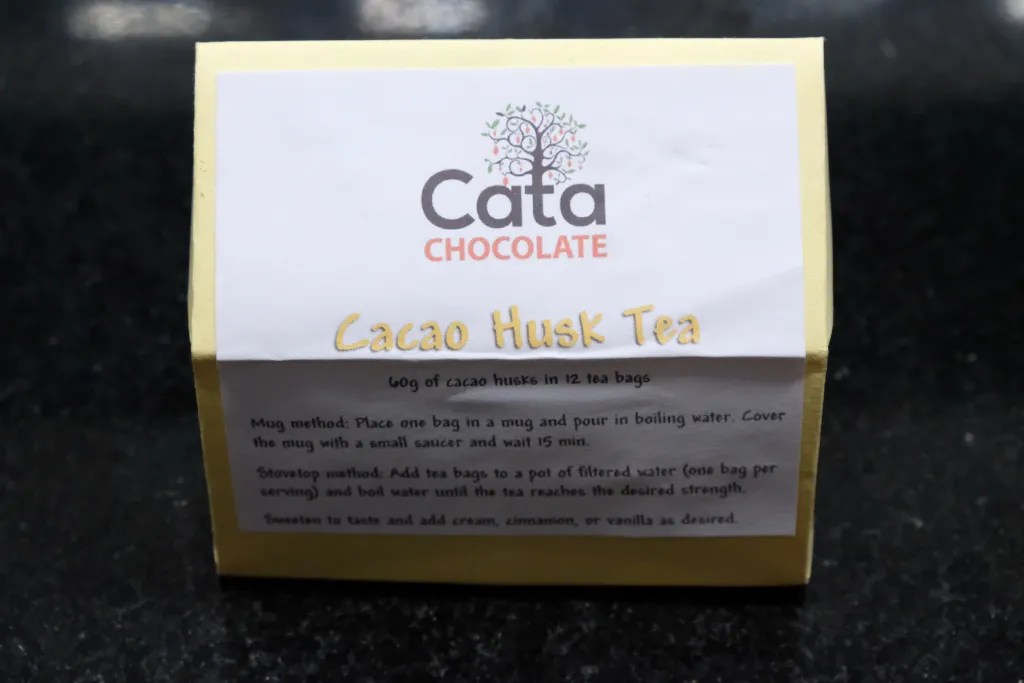
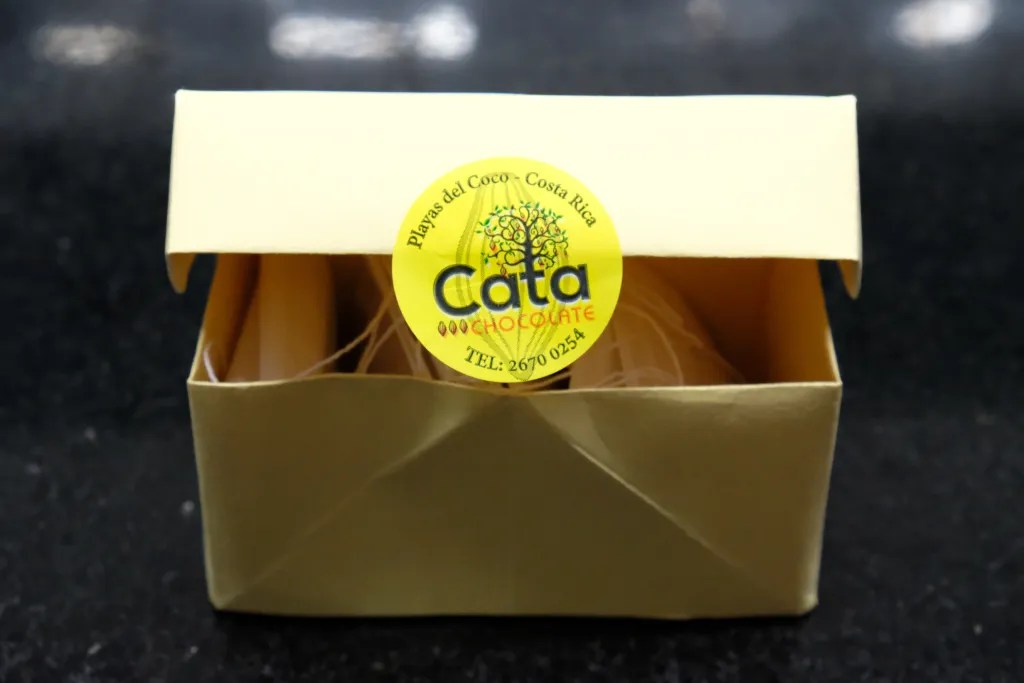
The kitchen is the best bit (in my opinion anyway). The winnower is an ex sunflower seed crusher that Chris found somewhere and converted for cacao, paired with a vacuum. The husks don’t go to waste either, they are bagged up as cacao shell tea, and because there’s no proper packaging yet, the boxes are folded into origami my hand.


They make 10kg batches of each flavour, about twice a week, sometimes up to three depending on demand. The 70% is the crowd pleaser across the board, more so than the milk. Interestingly, on taking all products to a local fair it is always the milk chocolate that is left sitting there at the end of the day. The 85%, similar to the 70% is another one to sell out fast, one assumes, because of the increased health benefits compared to the milk options. Freddy’s daughter’s own favourite? It’s Cata’s 60% “I’m lactose intolerant but I like my things a little sweeter,” she says. It’s a dark milk, made with coconut; dried coconut flakes dropped straight into the grinder, then conched for 42 hours until completely smooth. You can taste the coconut, but not feel it. No dairy at all, but all the creaminess. The 85% would be her second best, because that’s where you can really taste the profile of the beans, completely unmasked by anything else. She said that surprisingly little kids are of obsessed with it, and it works great for people trying to shift their palate towards dark chocolate.
Curiously, the one experiment that didn’t work was other people’s beans. Someone asked them once to make a 55% for children, and supplied beans that had already been roasted (and slightly burnt). The resulting 55% came out tasting darker than their own 85%. A favour that turned into a lesson, but one they are willing to learn from and try something new again in the future.
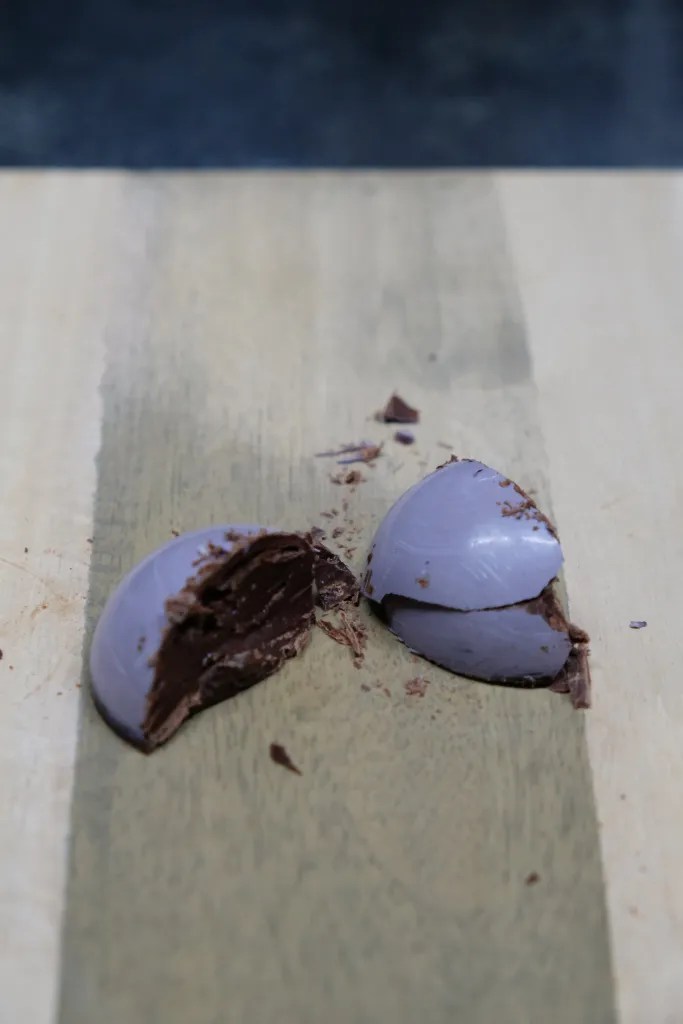
A typical week in production kind of looks a bit like this; beans are sorted by hand, which doesn’t take long, and then the whole process runs about two and a half days. Once it’s in temper, the chocolate goes into moulds before being left to set. The 85% can be out and packed within a few hours of the chocolate being released from said moulds, the 60% and the 55% need a couple of days to settle. Training the kitchen team took several months; the fillings are especially fiddly to get right, always the same amount of gel, always the same topping, with all the instructions (including those for Cocoa Crack) written on the whiteboards up around the kitchen, and meticulously written into thoroughly well-used notebooks.



Small, and perfectly formed on purpose, in this little pocket of northern Costa Rica just off the Gringo Trail, word travels fast and wide. There’s an export process underway, with interest from a supermarket chain in the USA. Messages arrive from Canada asking if they can make wedding favours. She handles the Instagram and Facebook accounts because her colleagues aren’t so up to speed on that, and she still sounds slightly amazed that it even works. “It’s really cool to see how people can find out about your products just from social media, from all over the world.” There might not be a far-reaching chocolate empire plan here, but that’s kind of not really the point.
Their desire, and passion, to remain small and agile should stand then in good stead in the future. “It’s a family thing and we don’t want to get too big. We just want a really good quality small batch product that we can share with people. The idea is to just keep moving forward and try and grow just a little bit more”.
And then I ask her, as I always do, one of my signature questions: What does chocolate mean to you?
Her response is something I truly, wholeheartedly agree on, “To me chocolate is such a great connector, conversation starter and gift giver, a great way to show love, and a way to truly express yourself. It’s such a universal thing and a really interesting product. It is a connector.” Which I think sums up this whole little chocolate ecosystem in one sentence. A lawyer, a biologist and a food engineering student, none of whom knew how to make chocolate initially, are learning off YouTube in a beach town in Costa Rica, because they wanted something no one else in Coco had. Now, people from all over the world are coming to this little sandy beach side town and climbing those wooden stairs up to the little shop, to discover the magic of chocolate all for themselves.
As we leave the shop Sam stocks up on more Cocoa Crack. Something tells me I’m going to need to work out how to make the recipe for when we leave.