From Bordeaux to the Bay – Coromandel Chocolate

It’s December and summertime in New Zealand, supposedly. We’re battling torrential rain as we take the winding road from Waihi to Whangamatā on the northeastern coast of the North Island, the kind of road where every corner and turn you take results in a new vista with the rain so torrential you hope your wipers can keep up. Whangamatā is a cute coastal town on the edge of the Coromandel Peninsula – surfing territory, holiday territory, the kind of place where the quintessential Kiwi bach outnumbers mansions and the sound of the ocean is never far away. Not the first place you’d expect to find a French-trained bean to bar chocolate maker, perhaps, but to Thomas Capdevielle, a keen surfer with a potent mix of salt and cacao in his blood, it couldn’t be more perfect.

Read more: From Bordeaux to the Bay – Coromandel Chocolate


Like all of the makers I visit on my chocolate quests, Thomas greets each and every one of his customers with a beaming grin and a head full of cacao knowledge he just can’t wait to share. Despite the rain, the shop is full. A steady stream of customers pours through during our conversation, each one battling against the wind to keep the door shut behind them. Thomas doesn’t miss a beat. He’s mid-sentence with me, then he’s behind the counter talking a customer through a tasting, then he’s back, picking up exactly where he left off. This, I quickly learn, is very much the Thomas Capdevielle way. His story begins in the south of France, in a small town near Bordeaux. Growing up, Thomas had a great crew of surfer mates, and one of them – along with his father – ran a chocolate factory. All the boys would work there over the winter holidays, saving up their money for surfing trips. It became a tradition: work in the chocolate factory, go surfing in Morocco, repeat. A pretty good life, by any measure. But Thomas took a little detour first, completing a masters in private law before the pull of chocolate and the ocean conspired to redirect his path entirely full circle. It was in fact, unsurprisingly, a surfing trip that first brought him to New Zealand, and to Whangamatā, where he initially intended to spend a year. But within a month he’d met Jess, who would become his wife, and that one year became two, and then, well, the rest is history.

What struck Thomas most about New Zealand at the time was the absence of something he’d always taken for granted. ‘In France,’ he tells me, leaning nonchalantly against the counter, ‘in the towns there is a butcher, a fish shop, and a chocolate shop. In New Zealand there was none of that, despite the fantastic resources.’ He was amazed. And where most people might simply note the gap and move on, Thomas decided to fill it. But he wanted to do it properly. Not half-heartedly, not on a whim. This meant heading back to France to complete a full four-year chocolate industry course at the CFA in Bayonne, in the heart of Basque country – a region steeped in chocolate history stretching back over five hundred years. The course included a three-year apprenticeship, structured in a rhythm of one week in school followed by three weeks in a chocolate factory. Over the duration this gave Thomas the opportunity to work with a multitude of different operations – expert bean to bar makers, traditional chocolatiers, covering all bases. It was a fundamentally profound experience, he says, one that gave him both the technical depth and the breadth of industry understanding he knew he’d need, a true and solid foundation.

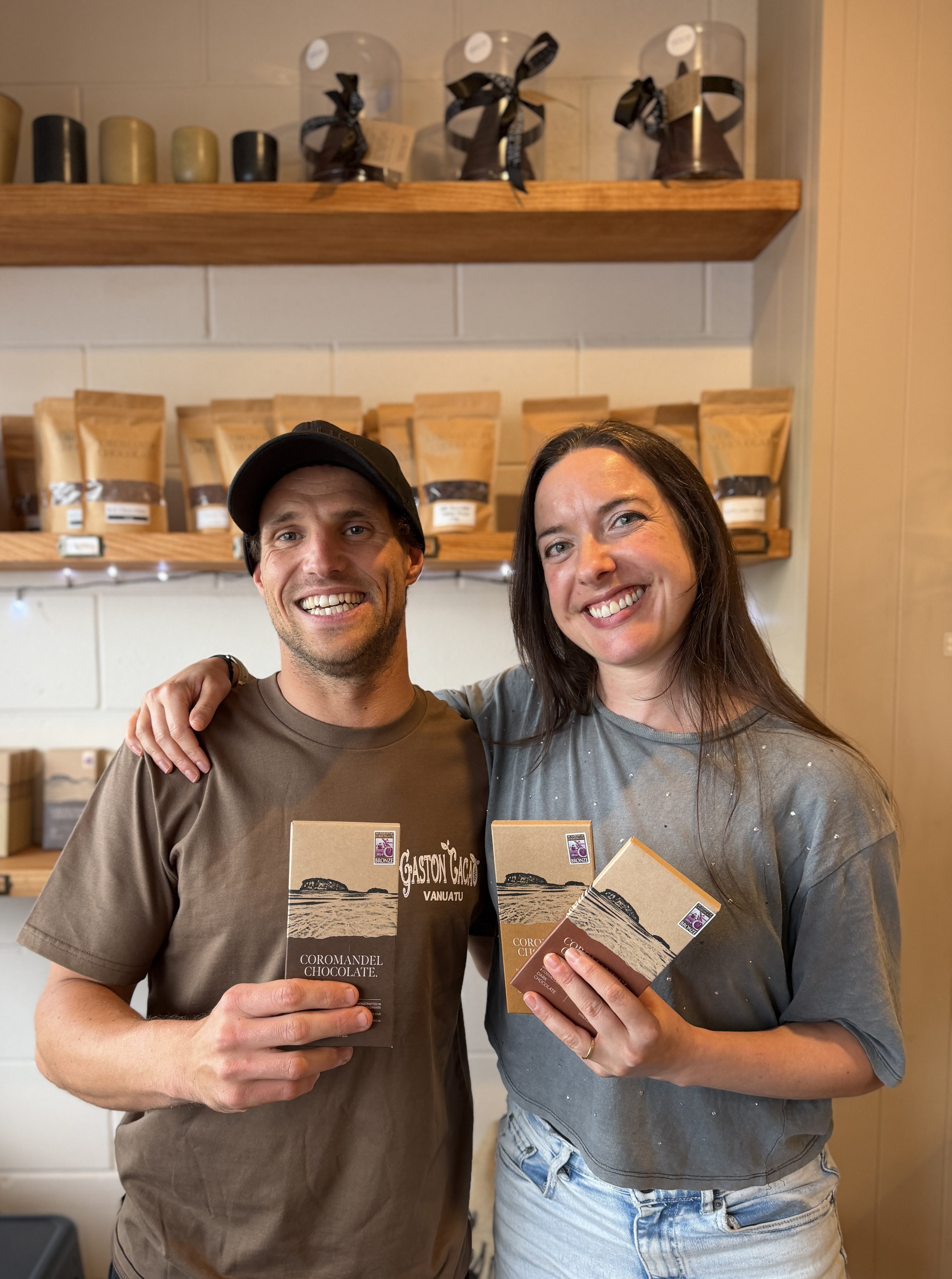
For his ‘memoir’ – the thesis component of his studies – Thomas set himself the task of mapping out how to open a chocolate shop in New Zealand, studying the full New Zealand market and relating it back to the French industry. He even began working through supplier contact lists while still in France, and it was about halfway through that process, emailing his way down the list, that he discovered Oli at Gaston Chocolat in Vanuatu. Two French surfers with a similar approach to life and work, they were just destined to work together.

Armed with his qualifications, Thomas returned to New Zealand and spent several years working with Honest Chocolat in Matakana, heading up the kitchen there and building his experience in the local industry before eventually taking the leap and striking out on his own. Coromandel Chocolate launched in February 2023, but before the doors opened there was the small matter of setting up a factory.

It’s safe to say that Thomas is not a man drawn to automation. He wasn’t interested in machines you could connect to a laptop and walk away from. He wanted the true, authentic, hands-on experience for his chocolate making – and so he sought out large, fully manual machines, some dating from the 1950s. His roaster, a magnificent 700-kilogram beast, had originally come from Kawau Island and found its way to Kerikeri, where it had sat idle for years before Thomas brought it down to Whangamatā and set about resurrecting it with the help of a friend, Pieter van Leeuwen from the Coromandel Cheese Company. It was a terrible machine in the beginning, Thomas tells me with a chuckle – that took a solid five months to rebuild. But I can see the way he looks at it, and all his manual machines for that matter, with a kind of fierce pride. Despite their age, the machines can handle ten to twelve kilograms at a time, which works out to roughly a sack of cacao beans every three days. That was plenty in the early days, and not too far from where things sit now. The beauty of the setup – and the layout of his shop, with its floor-to-ceiling glass windows looking into the factory – is that Thomas can roast while he runs the shopfront. He pops out to talk to a customer, darts back to check the roast profile, then returns to finish the conversation. The customer gets the heady fug of roasting cacao, the sight of beautiful old machines working their chocolate magic, and the opportunity to meet the maker himself. It’s theatre and education all rolled into one, and Thomas loves every minute of it. It’s not every day you walk into a chocolate shop and get to watch a world-class chocolate maker at work, and then talk to him as you choose which product to buy! I think it’s clear to see the entertainment factor appeals to him enormously.

And why Whangamatā? The answer comes without hesitation. ‘My wife is from here. And, I really believe Whangamatā has everything you need – three major cities within two hours, a full dairy and agriculture region. But I know what it takes to be a chocolate maker and to run a successful chocolate factory in New Zealand. There is no “I work five hours a day” – it is twelve hours at least, most days.’ He knew it would be tricky. He knew he needed to be in the best position possible to sustain that kind of work. ‘I need the ocean and I need the mountains and rivers not too far away. So I can work fifteen hours a day, but at least thirty minutes to an hour a day I am in the best position to be mentally balanced. That is why we are here.’

It’s a tricky location for business, that’s for sure. They endured a rough and long winter in the region, like most of New Zealand. But Thomas has his eye on the bigger picture. If Coromandel Chocolate can become a destination, a stop on the New Zealand tourist map, there’s potential that could really bolster the local economy. A busload of tourists who come for a chocolate factory tour are going to stay, head to a café, visit a restaurant, then go home and tell their friends about Whangamatā and the Coromandel. It’s good for the town, good for collaboration, it becomes a game where everyone wins. Even the packaging plays its part – designed as gifting packaging with Coromandel motifs, it doubles as a memento long after the chocolate is gone.

What strikes me most about Thomas, beyond his relentless energy and his obvious technical mastery, is his passionate commitment to transparency and ethics. When I ask about preconceived notions of the industry, he’s brutaly honest. ‘I think you never have the full vision of an industry before you enter it. Especially this one – it is so big, and the cacao industry is so dark and so bad in some ways, but also so beautiful in others.’ He pauses. ‘I had no clue the whole chocolate industry could be so dark.’ This is what drives his relationship with Oli and the cacao farmers of Pinalum, in Vanuatu’s Malekula Island. Thomas was there from the very beginning. He built the first dryer with Oli on his first visit, arriving with Clément, a friend from his old chocolate factory for surfing pocket-money days in France. His first order of beans from Oli was a full tonne – an audacious, bold purchase for someone initially working from his converted garage. Not many bean to bar makers starting out buy a tonne. But Thomas could see the impact, direct and tangible, and it’s only grown from there. Now he’s ordering three tonnes at a time, which for a factory that has only been officially in business since early 2023 is remarkable.

The logistics, though, are something else entirely. Thomas paints a vivid picture of the supply chain; the journey from Pinalum to the ferry, the ferry to the port, except the ferry is ten days late, then to Port Vila, Vila to Auckland, Auckland to Whangamatā. ‘So it only feels like it’s starting for me,’ he says, ‘when really that day is the easiest part.’ He speaks with deep respect for what Oli manages on the ground in Vanuatu, navigating a logistical reality that would test anyone’s patience. Having visited Pinalum myself and spent time with Oli and the farming communities there, and taking ‘that ferry crossing’ from Pinalum back to Port Vila, I can vouch for the extraordinary complexity and beauty of what they’re building together.

Thomas is equally passionate about the way New Zealand’s bean to bar community works together. He comes from a French tradition where collaboration between makers is simply how things are done, you’d pick up the phone and ask a neighbouring chocolatier if they had any spare butter, and nobody thought twice about it. He was surprised, early on, to encounter a somewhat more guarded attitude in some corners of the New Zealand scene, but that culture has shifted considerably. Today he communicates openly with makers across the country – sharing knowledge, comparing notes, even sharing recipe approaches he learned from some of the most prestigious chocolate factories in the south of France. He’s sat on the panel for six recipe books from those places, he tells me, and he shares them with anyone who asks. ‘We never pretend that we know better than anyone else,’ he says, ‘because we don’t.’ This spirit of openness extends to newcomers too. Just a couple of weeks before my visit, some aspiring bean to bar makers, Island Batch, from Waiheke Island had reached out. Rather than a phone conversation, Thomas insisted they make the drive to Whangamatā. They spent four hours with him. He showed them everything – the mistakes, the ups, the downs, the reality of what they were getting themselves into. ‘If your level of patience is high enough,’ he told them, ‘then just go for it. We need more people like you.’

One of the things he wishes people understood better about chocolate is, quite simply, where it comes from. That it’s a fruit. That most people wouldn’t recognise a cacao pod if they saw one. That the journey from tree to bar involves an extraordinary number of steps, both on the plantation and in the factory. His favourite way to explain the difference between bean to bar makers and chocolatiers (and he’s at pains to stress that both require extraordinary skill, dedication and precision) is to compare it to wine. ‘Imagine going to a winery,’ he says, his hands moving as he talks, ‘and you ask where are the vineyards. They explain, just like we do. Or they say we don’t grow the grapes, we source them from somewhere else – but we still process them ourselves. That’s what bean to bar is. But the chocolatier is different again – they’re buying a finished product and transforming it. Would you pay the same price and listen to the same story for both?’ People love this comparison, he tells me, because it illuminates something that’s never been illuminated before. Terroir, that magnificent French word for the way a place expresses itself through what it grows, synonymous with wine, is as real for cacao as it is for grapes. And Thomas hopes that every conversation he has with a customer sends a little bit of that knowledge out into the world.

On asking what he’s most proud of, Thomas goes quiet for a moment. ‘I would say I’m pretty hard on myself, so not much so far.’ He pauses. ‘But we have employed people. I’m an immigrant in this country who now has a business that can offer jobs in a small town. So I’m pretty proud of that I guess.’ He has a young apprentice from Invercargill who arrived knowing nothing about chocolate and is now, in Thomas’s words, acting like a true chocolatier. There’s also a half-Kiwi, half-Swiss team member who never thought she’d find work she loved in a small New Zealand town. ‘The proudest part for us is cacao, ethics, Pacific, and mostly being proud of improving the economy in a country we love and that gave us everything, and now we can give something back.’

The challenges are real and they come daily and without warning. Coromandel Chocolate started with ten thousand dollars in the bank and a garage. Now they’re in a two hundred square metre space with a shopfront and a growing wholesale operation, but Thomas knows they need a little more volume, a little more space. Cash flow is a constant companion (as every small business owner knows) and managing it alongside a young family, in a seasonal tourist town, requires a kind of patience that sometimes threatens to consume more of life than it should. ‘I try to sometimes put the patience down,’ he says, ‘and go back to the reality of: I really need to run a profitable business, and offer employment to people, and keep my wife.’

His biggest lesson? That owning a business is the biggest lesson of all. Having spent a decade working for other chocolate factories as an employee, becoming his own boss has been a revelation in the truest sense of the word. All the things he used to complain about as an employee now look very different from the other side of the counter.

As for ambitions, Thomas isn’t chasing scale for scale’s sake. He wants Coromandel Chocolate to become a well-known stop on the New Zealand tourist map. He wants to last, to be sustainable, to not be the kind of maker who gets bored after two years and moves on. There are plans to expand into the space upstairs, and exciting product development in the pipeline – a chocolate milk collaboration with a local dairy, inspired by the legendary Cacolac that has been produced in Bordeaux since the 1950s, which Thomas envisions serving through a self-serve refill station in the shop. He’s also exploring creative uses for cacao husk, which makes up around thirty percent of bean weight – bars of soap with ground husk are already in store, with ideas for scrubs and even essential oils for spas on the horizon. ‘We just want to be a chocolate factory that can last,’ he says, ‘that can create memories for families spending their time around the Coromandel. Core memories.’

When I ask Thomas about his biggest influences, the first name out of his mouth is Chocolat Cazenave in Bayonne – the legendary bean to bar chocolate house that has been producing chocolate since 1854, right in the heart of Basque country. It was here that Thomas completed his original apprenticeship, and the reverence in his voice as he describes it – the nineteenth-century machinery, the generations of memory baked into those walls – is palpable. He also speaks with great admiration for Haigh’s Chocolates in South Australia, and Maison Bonnat in Voiron – traditional French bean to bar makers he holds in deep respect. ‘I have a list of a million influences and influencers,’ he says, ‘so I will stop there.’

And what keeps him up at night? Not, perhaps surprisingly, the rising price of cacao. ‘I think raising the price of cacao, for the most part, is a very good thing,’ he says, a stance that speaks to his deep understanding of what farmers need to earn a sustainable living. What concerns him more is whether the small bean to bar movement can keep growing fast enough to survive. Whether enough consumers will understand that they need to buy chocolate locally, the same way they might buy meat from the butcher or fish from the fishmonger. Whether the independents can hold on. ‘Otherwise we will all disappear,’ he says quietly, ‘and then there will be nothing left.’

He’d like to see more support from New Zealand’s tourism infrastructure, visitor centres and information offices actively directing people to small bean to bar makers, not just the big established names. More recognition from corporates in Auckland and Wellington. More funding, more respect, more understanding of what the small makers actually go through. ‘They need to remember, you were small one day too,’ he says, and I can feel the conviction behind it.

As we step back out into the Whangamatā rain, already planning my return on a sunnier day, I find myself thinking about the unlikely poetry of Thomas’s journey. From Bordeaux to Bayonne to Morocco to Whangamatā. From law school to cacao. From a surfing trip that was meant to last a year to a life’s work built on chocolate, ethics, and an unshakeable love for a small New Zealand coastal town. The rain hasn’t let up, if anything it’s intensified. But behind me, through the floor-to-ceiling windows, I can see Thomas already back at his machines. The roaster still turning. That all too familiar cacao aroma filling the air. And a new customer has just walked through the door, fighting with the handle against the wind, to find a French-trained chocolate maker from Bordeaux bounding out from his kitchen, grinning at them from behind the counter, ready to share everything he knows about the world’s most fascinating food. In Whangamatā, of all places. And it’s just perfect.

‘Chocolate is Magic’ – Baron Hasselhoff

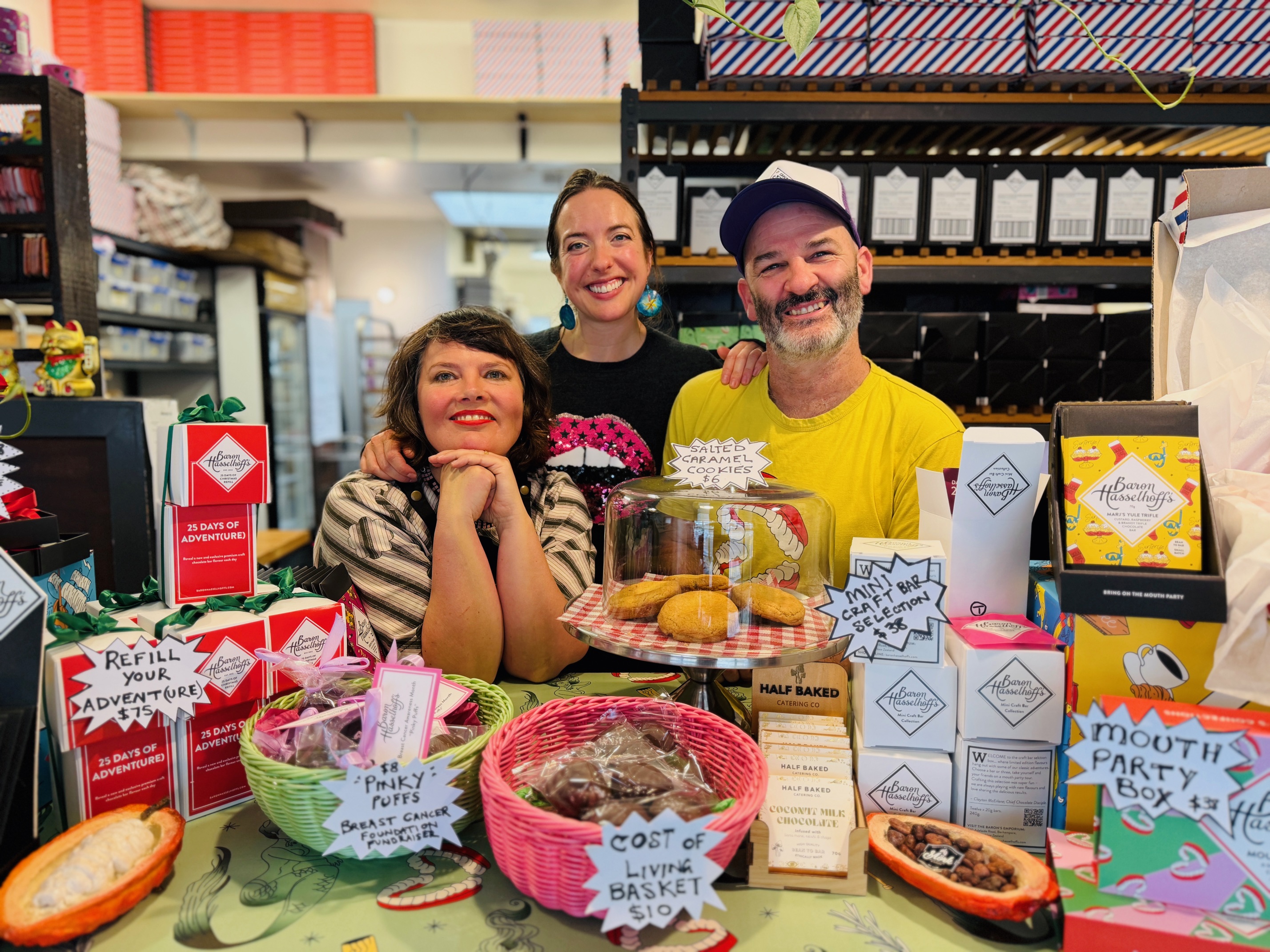
The smell hits you before the door has even closed behind you. Rich, deep, intoxicating, that unmistakable aroma of cacao being ground into something truly magical. It’s a grey Wellington morning on Adelaide Road in Berhampore, and there is a distinct bite and sprinkling of rain in the air. A typical spring day. But I’m not phased, I’ve just stepped inside Baron Hasselhoff’s, what one might describe as a mini chocolate emporium, and Clayton McErlane – Chief Chocolate Disciple, as he officially goes by – is behind the counter, melangeurs whirring and rumbling away in the background. Erin Todd, Clayton’s partner in chocolate and officially Chief Everything Else Officer is mid-conversation with their final customer of the day, but waves us in with a smile that says sit down, we’ll be with you in a sec.

Continue reading “‘Chocolate is Magic’ – Baron Hasselhoff”

New Zealand shines on the global chocolate map, scooping up awards across the board at the Academy of Chocolate 2025.

Having spent an inspiring few weeks last October judging for the UK’s Academy of Chocolate, I eagerly scrolled through the email in December announcing the winners. I knew New Zealand was in a strong position, but when the results came through I was blown away. Thirty medals, from just five makers in a country of barely 5.2 million people.

New Zealand may frequently get missed off world maps for all sorts of things, but our place was now even more firmly solidified on the world chocolate map!

Continue reading “New Zealand shines on the global chocolate map, scooping up awards across the board at the Academy of Chocolate 2025.”

Welcome to Wonderland

It was a bright yet blustery day in Wellington, the sun was shining but there was a distinct nip in the air, typical for late winter when the early hints of spring are just beginning to make themselves known. I was heading to Lyall Bay. Not to surf, although conditions were good. No, I was off to meet Kate Necklen, the creative mastermind behind the magic that is Wonderland Chocolate.

Continue reading “Welcome to Wonderland”

But Why Vegan? But Why Not?

It was a cold start in late July, leaving a wintery Wellington to head to an even more wintery Christchurch, having to scrape thick ice off the hire car on our arrival. But I was on a mission to interview New Zealand’s Outstanding Food Producer Awards winner Nel Vincencio, the mastermind behind Mind Your Temper, and no amount of ice or snow was going to stop me!

Continue reading “But Why Vegan? But Why Not?”

Wine is a Right of Passage

PASSAGE ROCK – WAIHEKE

It’s the last day of our Waiheke Island tour and I’ve developed a great feel for the place, early morning jogs along the beach, sunset walks, exploring beach-side and inland vineyards to compare the difference in the wine, dining on some of the most amazing fare and explored the amazing chocolate shops and dessert bars of mainland Auckland.

It was time for the last vineyard of our short stay, and we were not disappointed. Passage Rock Vineyard is in the south of the island, near Orapiu Bay.

The Passage Rock vineyard

Continue reading “Wine is a Right of Passage”

Chocolate and Wine is all You Need

With a surprisingly light hangover from the day before (once we returned from Man O’War we could’t resist opening some of the wine we’d purchased to take home with us – self restraint is hard with wine so good!) we began the day watching the sunrise from the balcony with a hearty breakfast before hopping across on the ferry to Auckland, for chocolate hunting…

Some sound chocolate advice from my Auckland adventures

Continue reading “Chocolate and Wine is all You Need”

A Vineyard by the Sea

Waiheke is one of those magical places that you think only exist in fairy tales, or the lives of super yacht owners. Luckily for Aucklanders, or anyone visiting Auckland, Waiheke is very easy to get to, only an hour’s ferry ride from Auckland harbour and at around NZ$20 one way that’s really not bad at all.

Slow down!
Slow down!

Continue reading “A Vineyard by the Sea”

Free-fall to Chocolate

Our time up North had sadly come to an end, and despite eating more than my fill of avocado and all manner of fish dishes – recipes can be found soon in the recipe section on this blog – it was now time to head South. I had a skydive session booked, chocolates to eat, more friends to meet and an Island of Wine to explore. Heading south we pass the Kaori store, featuring a staircase carved from a giant hollowed out Kaori tree!

Sitting in a tree

Continue reading “Free-fall to Chocolate”

Settlers of The Far North

HOUHORA TAVERN

Now for a little history of Northland. The nearest harbour to Ngataki – Houhora Harbour was home to whalers and Dalmatian Gum Diggers (no, not the dogs, but people from the balkan area now known as Croatia, but this is also where dalmatian dogs are from). The old Post Office and Dance Hall next to Houhora Tavern date back to these pioneering days when the Dalmatian Gum Diggers were digging their fortunes of kauri gum burried below the surface of surrounding areas such as Waiharara, where the Gum Diggers Park sits now.

Continue reading “Settlers of The Far North”